Monday, December 16, 2013

Van Gogh's Yellow


It is well known that the rise of Impressionism was due in part to the new developments in paint chemistry which created brighter, more stable colors previously unavailable for oil painting.
View of Arles with Irises by Vincent van Gogh, oil painting.


View of Arles with Irises by Vincent van Gogh, oil painting.


One of the artists who embraced and experimented with the new color technology was Vincent van Gogh. The brilliance of some of van Gogh's most famous fine art oil paintings are due to his use of these newly available vivid industrial pigments. These pigments begin to show up in his work after his move from Holland to France. Unfortunately, the chemists of the time did not have the tools to perform accelerated aging tests to determine the lightfastness over time of their new creations.
One of the colors, Chrome Yellow, is not only toxic, but is now also known to darken under exposure to the ultraviolet rays in sunlight. As less toxic alternatives to Chrome Yellow were finally developed in the mid-1900s, artists tended to switch to them. But, for a critical period of time, the brilliant color that Chrome Yellow provided was an important tool in van Gogh's and other artists' palettes. It was perhaps most famously used in some of van Gogh's Sunflower paintings. Researchers have found that some, but not all, paintings containing chrome yellow suffer from the severe browning that exposure to sunlight can cause.
To understand how paintings age and how best to preserve them for the future, researchers conducted an in-depth study of the browning seen in some of Van Gogh's work painted with Chrome Yellow. Scientists from four countries performed the study. They began by collecting samples from three historic chrome yellow paint tubes and artificially aging the paint for 500 hours using an ultraviolet lamp. They also took samples from two van Gogh paintings, View of Arles with Irises and Bank of the Seine. The paint from the tubes darkened to a chocolate brown after exposure to the UV light.
Using an X-ray beam that is one hundred times thinner than a human hair, the scientists were able to analyze the darkened chrome yellow at the very surface of the two paintings as well, just below the varnish. Their analyses discovered that the chromium in the pigment gained electrons from the UV light, effectively reducing Chromium (VI) to Chromium (III), turning bright yellow to brown.
Of great interest was the finding from the microscopic X-ray beam that the darkening was most prominent where chemical compounds containing barium and sulphur were. This may prove why some of Van Gogh's paintings seem to be especially susceptible to the darkening, as it is speculated that he sometimes blended white (containing barium and sulphur) with his yellow paint. The next phase of the research will be the most important of all in trying to understand if there is any hope to revert pigments to the original state in paintings where the darkening is already taking place.
In yet another blending of science and art, we are able to look backwards to understand more about the lives and the works of the great masters. "I am not aware of a similarly big effort ever having been made for the chemistry of an oil painting." - Joris Dik, Professor at Delft Technical University. (More information is available from the Journal of Analytical Chemistry.)


Please join us on The Artist's Road for more interesting and informative stories. We believe that more artists in the world is a good thing!
--John and Ann

She Nearly Threw Her Grandpa’s Scrapbook Away. Til She Opened It And… WHOA!

A Redditor discovered this scrapbook in her family’s home. It was musty, plain and almost falling to pieces. To most people, it may look like just a piece of junk that could be thrown away during a round of spring cleaning. She had a feeling it was special… and it ended up being absolutely priceless. Her great-grandfather was a cartoonist for Walt Disney, and inside of that scrapbook was some of the coolest sketches we’ve ever seen.
We don’t support hoarding, but if you see a tattered book in your family’s attic, you might just want to take a peek before you throw it away. It could contain priceless Disney gold!

Tuesday, November 12, 2013

Found in the Trash: A Box of Otherworldly Notes

In "Nostalgia

You know why the internet is awesome? Because you can share the experience of someone discovering a mysterious treasure. Reddit user TramStopDan documented and shared his recent experience of unlocking and discovering the contents of a box which his friend found discarded on the street next to the trash. When he managed to open it, Dan found a mind-boggling collection of posters, illustrations, text, maps technical drawings and personal belongings.
Speculating on the original owner of the case, Dan writes: “Clearly something happened to this guy that was very memorable. It measures roughly 29″ by 38″ and almost all the drawings are very large… It appears that he was making a diorama/tabletop display. (Why? I have no idea). There are numbered parts and instructions/explanations.”
So let’s take a peak at what he found…


Pretty normal so far…
Text on a poster with corrections and a few eyebrow-raisers to quote, such as, “…but after 12 years it developed that this picture of an obvious other-world invasion…”
‘Fairly small maps, hand-drawn on a clear-ish plastic-like material.’
They all have a hole in the middle, to be overlaid on something else.
Hmmm…
Getting weirder… (or cooler) …


And as Dan puts it, “begin the crazy”…
“Now things start to get a little odd. It seams that the artist saw something in Tampa, FL in 1977 that changed him … This appears to be an early sketch of the event”. 

“An obvious blending of the religious and the extraterrestrial…”

One Reddit commenter had this theory to add:
Apparently the guy went slightly insane over finding extraterrestrials in the bible. He was obsessed with “living creatures” described in Ezekiel 10 that are described as having four faces: “the first face was the face of a cherub, and the second face was the face of a man, and the third the face of a lion, and the fourth the face of an eagle.” I guess he really wanted for that to be an alien encounter.

Also found in the briefcase was this technical drawing that looks like a patent application, quite large and very detailed. Dan looked but could not find any registered patent of this design.


So there’s your daily dose of “what the heck am I looking at?!”

Wednesday, November 6, 2013

Don’t Give It Away for Free!

by Jillian Steinhauer 
Screenshot of Jessica Hische's shouldiworkforfree.com (© Jessica Hische)
Detail of Jessica Hische’s shouldiworkforfree.com flowchart (screenshot by the author, © Jessica Hische)
Last week, a New York Times opinion piece fired up my Facebook newsfeed. Titled “Slaves of the Internet, Unite!” and penned by Tim Kreider, the piece pleads with writers not to indulge in that pervasive and pernicious cultural habit: writing for free.
Kreider’s op-ed is funny, smart, and over-the-top, which occasionally leads to some stretching of his argument. (He compares his situation with that of his sister the pulmonologist, saying no one asks her to perform a free lobectomy in her spare time, but I’m not quite sure I buy the comparison.) It also leads to gems that any writer struggling to eke out a living will savor:
This is partly a side effect of our information economy, in which “paying for things” is a quaint, discredited old 20th-century custom, like calling people after having sex with them. The first time I ever heard the word “content” used in its current context, I understood that all my artist friends and I — henceforth, “content providers” — were essentially extinct.
And this:
Not getting paid for things in your 20s is glumly expected, even sort of cool; not getting paid in your 40s, when your back is starting to hurt and you are still sleeping on a futon, considerably less so. Let’s call the first 20 years of my career a gift. Now I am 46, and would like a bed.
Kreider ends with a rallying cry asking other writers not to give it away for free, so as to help lift the boat for all of us, or however that metaphor goes.
When I read Kreider’s piece, part of me immediately wanted to trumpet his message everywhere; another part of me admitted all too readily that the issue is complicated. In this day and age, writing for free brings with it real benefits, the most obvious of which is the chance to write for money; that’s how mine and I’m sure countless other careers started.
People tend to blame the internet for the downfall of the livable writing wage, which I think is probably accurate. People also tend to laud the internet for bringing a greater number and wider range of voices into the cultural conversation, which I think is probably accurate as well. But writing — like art — still has a major diversity problem, as well as a gender one. We remain far from the utopian democratization proposed by the evangelists of Web 2.0.
One aspect of the diversity-in-writing discussion that I’ve found noticeably absent is any mention of class, most likely because you’d need real, hard data to understand the economic backgrounds of working writers. But I venture to guess that if you did have the results, you’d find a whole lot of people who come from middle- and upper-class backgrounds and not so many from lower.
Choosing writing as a profession is an economic risk. Having a safety net, like a family you’re pretty sure won’t let you don’t end up homeless, helps. Easy access to education also helps, both emotionally (confidence) and materially (contacts, connections). A sense of entitlement definitely doesn’t hurt. A recent opinion piece in the Guardian by Chris Arnade, a Wall Street banker–turned–photographer, was overly simplistic but made a solid point:
I am able to take risks as an artist because I have money. … we rarely hear the stories of the poor as told by them. If they are told, it is by other artists who come into the neighborhood and interpret what they see.
Paying writers — and artists, and musicians, and photojournalists, etc. — matters, for a myriad of reasons. One of the strongest is that, without it, we’ll never really achieve that long-overdue democratization. Not until we find a way to make these creative pursuits viable professions.


http://hyperallergic.com/90638/dont-give-it-away-for-free/

Monday, June 17, 2013

Treat Your Imagination to Daniel Merriam’s Fantasy Surrealism

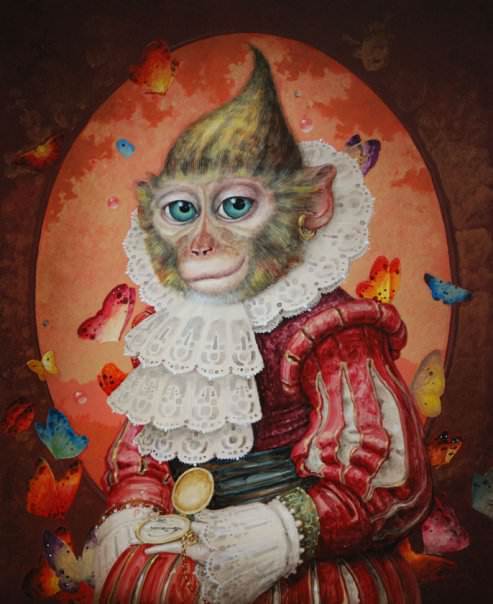
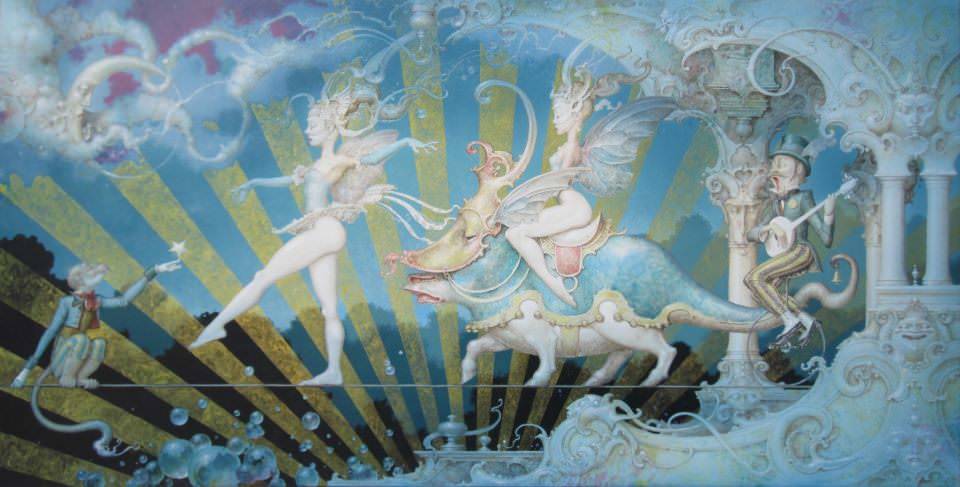
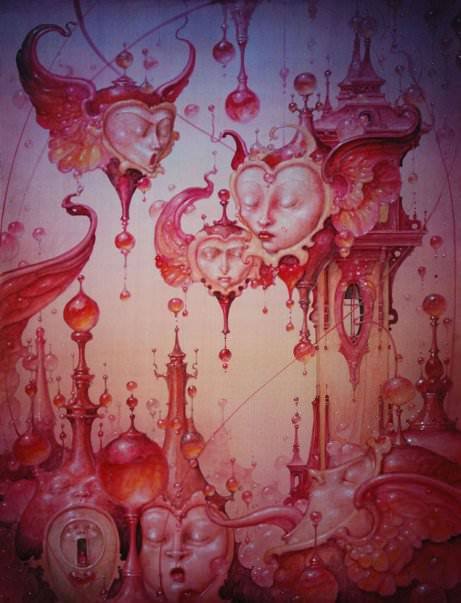
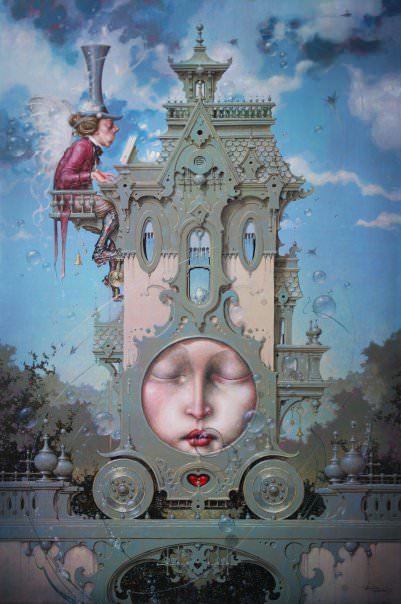
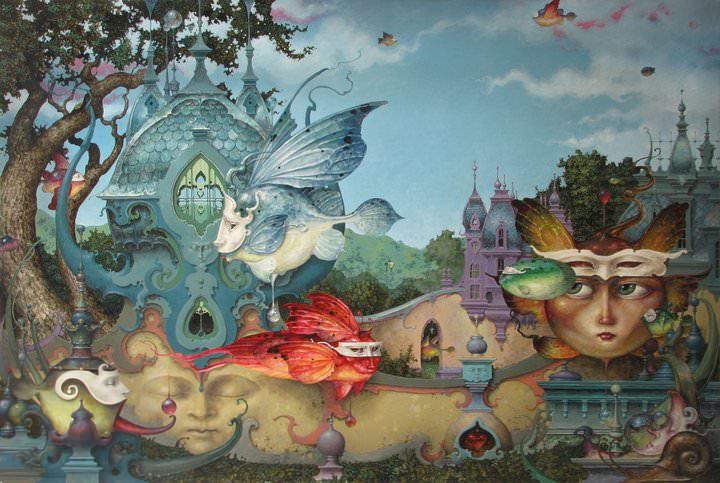
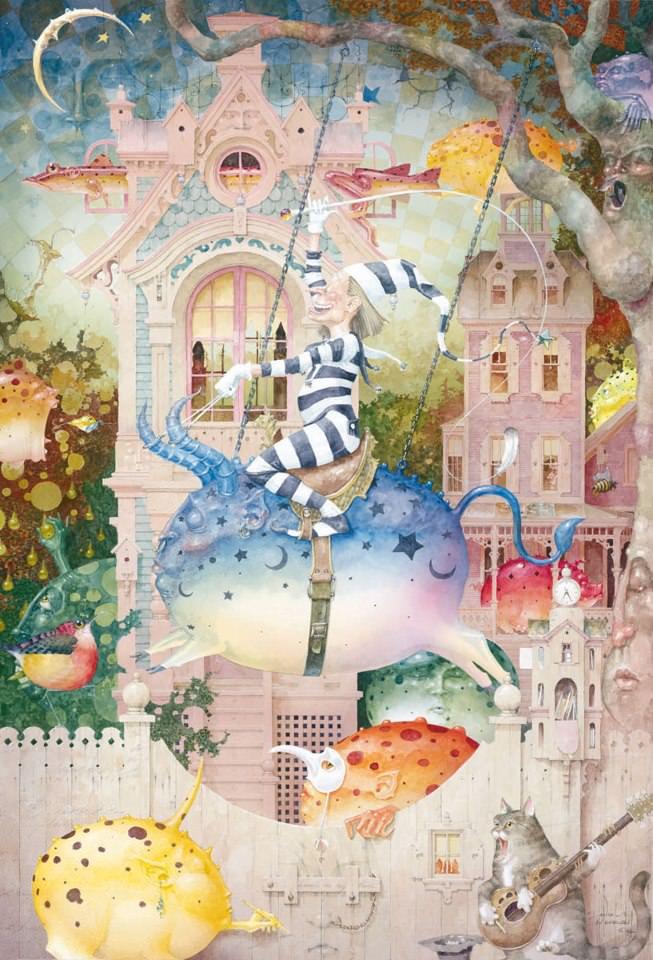
 Daniel Merriam was born on February 1, 1963 in a small town in Maine, USA. He was one of seven artistic children and so was surrounded by creative pursuits as a child. He began exploring his artistic skills by drawing cartoons for his high school paper and went on to become a professional architectural designer. His architectural illustrations won many awards and inspired Merriam to take up painting as a full-time career. It was a move that has brought value to the genre of modern surrealism, as Merriam’s art exhibits an aspect of curiosity that was previously lacking in the movement. Fantastic creatures frolic in his art works while pensive humanoids express the inner world of the artist in silent mime, asking nothing of the viewer but that they travel into Merriam’s fantasy world and delight in his alternate reality.
Unlike many surrealist works, Merriam’s art isn’t a reflection of society, suffering or the emotional angst of the artist. Instead his paintings portray opinions of emotion, history and nature that are based purely in the realm of curiosity. There is a sense of child-like romanticism in the beauty of his fantasy realms that is balanced with a maturity of technical skill. This is the work of an artist who has dedicated his time and energy to the pursuit of form as an expression of ideas and imagination.
Daniel Merriam has published two books of his fantasy surrealist paintings, The Impetus of Dreams and The Eye of a Dreamer. You can find out more about these books and see more watercolor paintings by Daniel Merriam on his website. Try out these links for online art galleries that sell prints of Merriam’s art, or join his Facebook page for updates from the artist.


http://mayhemandmuse.com/treat-your-imagination-to-daniel-merriams-fantasy-surrealism/