
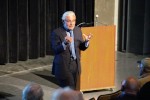
Author Marcelo Suarez-Orozco speaking at the reading summit in Vancouver in May.
This fall, Canadians will see the launch of a national reading
campaign in their newspapers, magazines, on television and in bus
shelters. The public awareness campaign will focus on the importance of
reading and the joy of it.
The central message is that reading is a great pleasure, says Patsy
Aldana, publisher of Groundwood Books who co-founded the campaign and
with Annick Press director Rick Wilks.
The publicity campaign is only the first element in a plan unveiled
and discussed at a summit attended by about 130 educators, publishers,
librarians, educators, writers, parents and students in Vancouver in
early May. It was developed and shaped by input at two previous summits
in Montreal in 2011 and in Toronto in 2009.
“The ultimate goal of the National Reading Campaign” according to its website,
“is to create a strategy that will promote reading amongst all
Canadians; Reflecting the value of reading as a tool for democracy and
civic engagement, as a means to equalize the playing field for all
Canadians, as a way for Canadians to learn about themselves, and as a
vehicle for joy.”
While the campaign will aim to encourage reading among all sectors
of Canadian society, special attention will be paid to aboriginal people
and new immigrants in Canada. “Of course, children are crucially
essential in all of this,” Aldana adds, “because if you are turning
children out of schools who don’t want to read, then you really are
jeopardizing the future of reading,”
Indeed, there is evidence that reading may be being endangered by
education systems that intend to promote it. A survey of 240,000
children in grades 3 and 6 in Ontario reported in 2011 that 50% of the
students said they liked to read. That is down from 75% of grade 3
students and 65% of grade six students in 1999. The drop is alarming,
says Aldana, and cause to re-examine the way reading is being taught to
children.
Prominent scholar and author Marcelo Suarez-Orozco, who has been named dean of education at UCLA, spoke at the Vancouver summit. He
suggested that while tests help schools see what they are not
succeeding at teaching, the heavy emphasis on testing and test scores in
many schools and education systems is killing the joy of learning for
students. While there may be no way to eliminate testing, he recommends
giving students more time and space to enjoy learning.
Aldana added that the organizers of the campaign are interested in
discussing current teacher training and new ways that that they could
promote reading, such as giving students more time for free reading and
choice about the books they read. Books on the curriculum deserve some
careful examination as well. “Kids in Ontario are still reading The Chrysalids,”
she said. “It’s a fine commercial book from the '40s, but what on earth
is it still doing on the curriculum in Grade 8 in Ontario? It has zero
relevance.” Educators such as the Canadian deans of education have been
very receptive to the campaign so far, Aldana said.
Although the campaign is not directly advocating for public
libraries, part of its message is that “public libraries are at the
heart of our reading society,” she added.
Another priority identified was a need for Canadian research on
reading, which Aldana said will be a major activity funded on a project
by project basis. The National Reading Campaign is being established as a
not-for-profit organization, which will employ a secretariat of one
person. The campaign is seeking funding, but most of it will come from
private sources rather than government, she said.
The publishing community is already completely onside, Aldana
noted. “The ACP [Association of Canadian Publishers] and the CPC
[Canadian Publisher’s Council] are both supporting us in substantial
ways – with money and with time.”


