The
scratchy, angular work of the illustrator Quentin Blake – who
celebrates his 80th birthday on 16 December – is instantly recognisable.
But, Jenny Uglow argues, he is still a master of the unexpected

Quention Blake's Mrs Armitage: 'Bumpers? Who needs them?' Photograph: © Quentin Blake
Crouching in a bookshop, at small-child height, in front of the
picture books, I found myself laughing at familiar scenes. Here is Mrs
Armitage in her rickety car, with great weights descending "kerplunk" as
she hurtles along: "Bumpers? Who needs them?" Here is Mr Magnolia, with
his sisters and parakeets and mice, and rhymes any two-year-old can
bellow, "BOOT", "HOOT", "ROOTY-TOOT". Here is Angela Sprocket, with a
pocket for everything, even the kitchen sink, and the magical Green
Ship, steering into the eye of the storm. All are creations of Quentin Blake. Words come to mind: exuberant, chaotic, comic – joyous.
On a table nearby are books for older children, in which
Blake's drawings illuminate other people's texts. He may be benign, but
he has a mercurial wit, a cartoonist's eye for the telling gesture, a
spiky morality, a gleeful touch of anarchy. He can do smelliness well,
such as the matted beard and clouds of stench in David Walliams's Mr Stink. And his long collaboration with Roald Dahl showed that he can do nastiness too: the horrible Twits, the grumpy grandmas and beastly aunts, the frightening Grand High Witch with her evil drool, the gloating red-tongued wolf of Revolting Rhymes.
Yet any darkness is filtered by humour. For years now, children have
seen these characters as he drew them, from the BFG in his sandals and
Willy Wonka in his hat to Matilda with her tower of books.
Blake's scratchy, knobbly, angular style may be immediately recognisable, but he is still a master of the unexpected. Celebrating his 80th birthday on 16 December, he is tetchily pleased that his new exhibition at the Marlborough Fine Art Gallery isn't a retrospective – as if he were a grand old man at the end of his career – but a show of new, intriguing, thought-provoking work. When the gallery invited him to make etchings and lithographs, he grasped the chance, even though – or perhaps because – these were unfamiliar media. Eventually, he produced mysterious etchings of women and birds and jewel-tinted humanoid insects; lithographs of girls with dogs; strange, disembodied heads of women floating in water, like archaic fragments from the depths; bouncing, vividly coloured, nude Sporting Women; and haunting drawings of Companions and Characters in Search of a Story. All the sequences are, he feels, "like illustration pulled inside out". Instead of pictures supporting a text, viewers provide their own narratives. The effect is unsettling, taking us to some edge, a borderland of metamorphosis.
As Blake describes it, there has always been something provisional, rather than planned, about his working life. At the end of a short video about drawing, made some time ago, he said that whenever he delivered a book, his publisher always asked if he had any ideas about what he would do next. "Well, of course I don't have any ideas – in fact I'm convinced I will never have any ideas. But I have to try, and I think about things I would like to draw. I organised an exhibition called Magic Pencil, and there you could buy a 'magic pencil' – and I bought lots of them – of course they're not magic really, they just draw in lots of different colours – and I thought, if I drew something with them, I might find something that will make a book in the end."
I suspect that, secretly, he probably does have a magic pencil. Like Hogarth, he defies the limits of the visual by evoking sound: saucepans crash, birds screech, flutes toot. His hairy monsters, weird animals, knowing children and baffled adults threaten to leap off the paper. Noses point, arms flap, legs twist at impossible angles. In Mrs Armitage on Wheels he deliberately gave his heroine a scarf to blow in the wind, to impart the feeling of movement, the breath of air. Movement, freedom, escape are of the essence. And in every case, the open line and feeling of improvisation allow readers space to let their own imagination work on how characters might look and behave.
A certain liberty pervades the very way he works. His studio, the front room of his Earls Court flat, has an air of potential, as if the paper and colours and pots of pencils, the boxes and books, the notes propped on the mantelpiece, the drawers crammed with sketches, will get to work by themselves. Standing amid all this, beaming, like a slighter, slimmer version of Phiz's drawings of the Cheeryble brothers in Nicholas Nickleby, Blake is enthusiastically precise about the exact make of his crayons, the quality of paper, yet hesitant about his own new work. He can be taken aback by what emerges as he draws. "If I try to think about it," he says, "there seem sometimes to have been periods of a sort of absent-mindedness when ideas think of themselves."
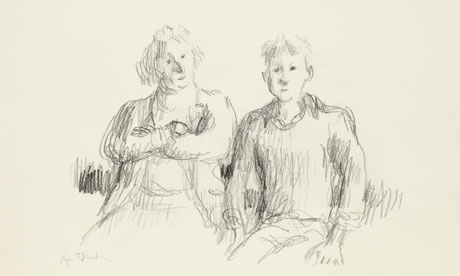 Companions XI Photograph: © Quentin Blake/Marlborough Fine Art
The air of spontaneity floats, one realises, above a lifetime of
patience, graft and long-practised skills. He has the artist's demanding
perfectionism, an obsessive need to "get things right". For his
illustrations, he produces a sequence of roughs, working out the look of
the characters, the best moments for depiction, the disposition of the
page. Are the characters consistent? Does the action carry on from page
to page? Next he places the sketches on the lightbox, with a sheet of
watercolour paper above, and reworks them in ink, never as exact copies
but transcriptions in another form. Even then he re-draws twice, three
times, four, five. He likes odd tools – the random scratches of the
quill, the fluid sweeps of the bamboo pen. Both are ancient tools, and
both are slightly unpredictable. "You get a more adventurous feel from a
scratch pen," he says, remembering how a woman in France sent him a
feather from a vulture's wing, that he sharpened into a quill – "rather
splendid". When he applies colour, he doesn't care if the watercolour
escapes the lines: "It makes it feel as if there is something
happening."
Companions XI Photograph: © Quentin Blake/Marlborough Fine Art
The air of spontaneity floats, one realises, above a lifetime of
patience, graft and long-practised skills. He has the artist's demanding
perfectionism, an obsessive need to "get things right". For his
illustrations, he produces a sequence of roughs, working out the look of
the characters, the best moments for depiction, the disposition of the
page. Are the characters consistent? Does the action carry on from page
to page? Next he places the sketches on the lightbox, with a sheet of
watercolour paper above, and reworks them in ink, never as exact copies
but transcriptions in another form. Even then he re-draws twice, three
times, four, five. He likes odd tools – the random scratches of the
quill, the fluid sweeps of the bamboo pen. Both are ancient tools, and
both are slightly unpredictable. "You get a more adventurous feel from a
scratch pen," he says, remembering how a woman in France sent him a
feather from a vulture's wing, that he sharpened into a quill – "rather
splendid". When he applies colour, he doesn't care if the watercolour
escapes the lines: "It makes it feel as if there is something
happening."
Blake has drawn ever since he can remember, certainly from the age of five. As the general view was that no one could make a living as a cartoonist or an artist, he read English at Cambridge, did his National Service and studied for a teaching diploma, and then took life classes at Chelsea School of Art. For 20 years he taught at the Royal College of Art. But during all that time he kept drawing, sending work to Punch when he was 16. In 1960, he illustrated his first children's book, A Drink of Water, written by his friend John Yeoman, moving from simple comedy to book illustration because he wanted to take drawing beyond the world of jokes into a realm that could embrace narrative and where he could control the sequence and design. Since then he has illustrated about 300 books, from nursery rhymes to the Folio Society's Don Quixote.
He was among a new wave of British illustrators who began work in the 1950s and 60s, an extraordinary flowering, benefiting from the greater availability of four-colour half-tone printing. The brilliant artists of that generation, each with their distinctive signature, still seem fresh. It's extraordinary to find that Shirley Hughes, Judith Kerr and Peter Firmin are in their 80s, while Raymond Briggs, Helen Oxenbury, David McKee and Tony Ross were all born, like Blake, in the 1930s. A galaxy of later stars have followed and authors and illustrators have often formed notable partnerships: Oliver Postgate and Peter Firmin, Allan and Janet Ahlberg, Julia Donaldson and Axel Scheffler, and, of course, Dahl and Blake.
Blake is passionately committed to his art, a generous promoter of younger talent and a prime mover in the House of Illustration, now working on establishing a permanent gallery. As the first children's laureate, 1999-2001, Blake encouraged all children to draw and paint, and he remains a tireless supporter of the annual Big Draw. I have seen him hold an audience of 1,200 spellbound, with children perched on adults' shoulders, just by drawing on an overhead projector, talking quietly: a nose, a line, a zig-zag, a big curve, a few more lines, and there is a crocodile balancing upside-down. He makes us feel we can all have a go. Introducing the translation of Daniel Pennac's bracingly funny The Rights of the Reader, he speaks out against the British taste for tests and targets, as well as the constraining grid of French "dry respect for art and letters". Behind both, he wonders, "is there a sort of fear of the rich, fluid diversity of the material", of the administrator's loss of control? "How satisfying, by contrast, the reassurance of a well-ticked box."
As head of illustration at the RCA, he must have been a great teacher. Scholarly yet fluent, he writes engagingly about the traditions of his art. For the Hayward Gallery touring exhibition In All Directions, for example, he traced illustrators of travel from Giandomenico Tiepolo to Honoré Daumier to Edward Ardizzone and John Burningham, with detours into Japanese and Indian art. In the BBC's Great Lives series he championed George Cruikshank, who drew the original Fagin and the Artful Dodger. He is entranced by moments of experiment, like the first showing of Degas's bronze La Petite Danseuse de Quatorze Ans, when Parisians fled offended: "A sort of exploratory skirmish along the borders of the artificial and the real," full of inner tension and energy, a metaphor for courage.
His first independent book, Patrick, published in 1968, was a story of art – in that case music – turning dull, monochrome lives into vibrant colour. (It was also a canny fight against being confined to black and white illustrations – to make its point, it had to be printed in colour.) In recent years, often working with the Nightingale Project in Kensington, he has expressed this optimistic belief in the transformative power of art in his work for hospitals and health centres. These have included jubilant images of older people cavorting, playing music and swinging in trees, for a residential ward; simple scenes of walking in the rain or feeding the birds for patients with eating disorders – the balm of the ordinary; and colourful, teetering circus folk for a mental health ward for older people, a reminder that however odd they look, older people still have "skills honed over the years, still fluent and functioning". For a centre for children and young people, he created Planet Zog, where stalk-eyed creatures stick out spotty tongues and green consultants scribble notes: not with any solemnly therapeutic aim, but just showing people "in strange situations which they are more or less coping with". It must be brilliant to have those pictures on the walls, a friend said recently. "Whatever they show, they're so life-affirming. How could you look at them and not smile?"
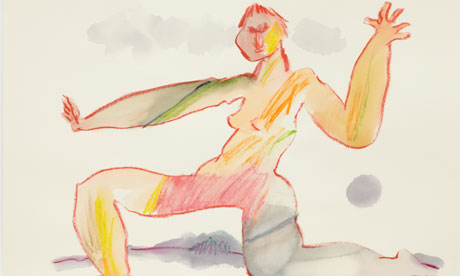 Sporting Women II. Photograph: © Quentin Blake/Marlborough Fine Art
For a maternity hospital in Angers, where the mood is more
celebratory – though tension is there, nonetheless – Blake adopted a
swimming theme, with rococo swirls of seaweed. This was not merely a
reminder of the amniotic fluid or the way that newborn babies swim
naturally, but a way of imparting movement and freedom, the feeling,
while in labour, that "something is just around the corner". But Blake
is not one for glib consolation or empty promises. His drawings of
solitary figures and couples in the Marlborough Gallery exhibition are
ruthless in their scrutiny, as well as compassionate. Some figures
clutch small objects: a purse, a pair of glasses, a piece of paper.
Exposed and anxious, they are unsmiling, and sometimes hostile. He has
an affinity with lost souls, as well as a sense of fun. Michael Rosen,
who has worked with Blake on many books, including the moving Sad Book,
agrees: "I think there is a theme running through much of his work of
isolated people going about some kind of slightly fantastical matter of
sorting things out – Mr Magnolia, Mrs Armitage. As adults, we may well
read loneliness, sadness into these but we don't know if the egocentric
child reader reads these partner-less, childless people as
extrapolations of themselves, in the mode of grappling with only having
one shoe or disappearing cockatoos and so on. They are, more often than
not, a child's dilemma blown up big."
Sporting Women II. Photograph: © Quentin Blake/Marlborough Fine Art
For a maternity hospital in Angers, where the mood is more
celebratory – though tension is there, nonetheless – Blake adopted a
swimming theme, with rococo swirls of seaweed. This was not merely a
reminder of the amniotic fluid or the way that newborn babies swim
naturally, but a way of imparting movement and freedom, the feeling,
while in labour, that "something is just around the corner". But Blake
is not one for glib consolation or empty promises. His drawings of
solitary figures and couples in the Marlborough Gallery exhibition are
ruthless in their scrutiny, as well as compassionate. Some figures
clutch small objects: a purse, a pair of glasses, a piece of paper.
Exposed and anxious, they are unsmiling, and sometimes hostile. He has
an affinity with lost souls, as well as a sense of fun. Michael Rosen,
who has worked with Blake on many books, including the moving Sad Book,
agrees: "I think there is a theme running through much of his work of
isolated people going about some kind of slightly fantastical matter of
sorting things out – Mr Magnolia, Mrs Armitage. As adults, we may well
read loneliness, sadness into these but we don't know if the egocentric
child reader reads these partner-less, childless people as
extrapolations of themselves, in the mode of grappling with only having
one shoe or disappearing cockatoos and so on. They are, more often than
not, a child's dilemma blown up big."
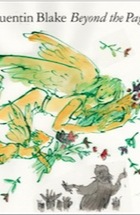
Not all dilemmas can be solved, but Blake knows this too. His real interest, he says, is in the possibility of metaphor: "Cockatoos is also about adults not understanding children, The Green Ship about time, and of course Zagazoo is pure diagrammatic metaphor." The great thing is to keep on, thinking through the ideas, working on those drawings, trusting that "something may happen". In the past decade, as he explains in his recent book, Beyond the Page, his art has moved into public spaces, on to walls and beyond, growing first into banners and then into drawings five storeys high, wrapped around the scaffolding at St Pancras in London, and exploding on to stamps, tea-towels, wallpaper, cards. Perfectly right then that in the new exhibition he looks forward, not back, as a more decorous artist might in his 80th year. Who knows, after all, what Quentin Blake may do next?
• Quentin Blake: New Lithographs and Drawings is at Marlborough Fine Art Gallery, London W1, until 11 January 2013; Quentin Blake 2012 is at Chris Beetles Gallery, London SW1, from 9 December to 5 January 2013.
http://www.guardian.co.uk/books/2012/dec/14/quentin-blake-illustrations-80th-birthday
- Beyond the Page
- by Quentin Blake
-
Blake's scratchy, knobbly, angular style may be immediately recognisable, but he is still a master of the unexpected. Celebrating his 80th birthday on 16 December, he is tetchily pleased that his new exhibition at the Marlborough Fine Art Gallery isn't a retrospective – as if he were a grand old man at the end of his career – but a show of new, intriguing, thought-provoking work. When the gallery invited him to make etchings and lithographs, he grasped the chance, even though – or perhaps because – these were unfamiliar media. Eventually, he produced mysterious etchings of women and birds and jewel-tinted humanoid insects; lithographs of girls with dogs; strange, disembodied heads of women floating in water, like archaic fragments from the depths; bouncing, vividly coloured, nude Sporting Women; and haunting drawings of Companions and Characters in Search of a Story. All the sequences are, he feels, "like illustration pulled inside out". Instead of pictures supporting a text, viewers provide their own narratives. The effect is unsettling, taking us to some edge, a borderland of metamorphosis.
As Blake describes it, there has always been something provisional, rather than planned, about his working life. At the end of a short video about drawing, made some time ago, he said that whenever he delivered a book, his publisher always asked if he had any ideas about what he would do next. "Well, of course I don't have any ideas – in fact I'm convinced I will never have any ideas. But I have to try, and I think about things I would like to draw. I organised an exhibition called Magic Pencil, and there you could buy a 'magic pencil' – and I bought lots of them – of course they're not magic really, they just draw in lots of different colours – and I thought, if I drew something with them, I might find something that will make a book in the end."
I suspect that, secretly, he probably does have a magic pencil. Like Hogarth, he defies the limits of the visual by evoking sound: saucepans crash, birds screech, flutes toot. His hairy monsters, weird animals, knowing children and baffled adults threaten to leap off the paper. Noses point, arms flap, legs twist at impossible angles. In Mrs Armitage on Wheels he deliberately gave his heroine a scarf to blow in the wind, to impart the feeling of movement, the breath of air. Movement, freedom, escape are of the essence. And in every case, the open line and feeling of improvisation allow readers space to let their own imagination work on how characters might look and behave.
A certain liberty pervades the very way he works. His studio, the front room of his Earls Court flat, has an air of potential, as if the paper and colours and pots of pencils, the boxes and books, the notes propped on the mantelpiece, the drawers crammed with sketches, will get to work by themselves. Standing amid all this, beaming, like a slighter, slimmer version of Phiz's drawings of the Cheeryble brothers in Nicholas Nickleby, Blake is enthusiastically precise about the exact make of his crayons, the quality of paper, yet hesitant about his own new work. He can be taken aback by what emerges as he draws. "If I try to think about it," he says, "there seem sometimes to have been periods of a sort of absent-mindedness when ideas think of themselves."
Companions XI Photograph: © Quentin Blake/Marlborough Fine Art
The air of spontaneity floats, one realises, above a lifetime of
patience, graft and long-practised skills. He has the artist's demanding
perfectionism, an obsessive need to "get things right". For his
illustrations, he produces a sequence of roughs, working out the look of
the characters, the best moments for depiction, the disposition of the
page. Are the characters consistent? Does the action carry on from page
to page? Next he places the sketches on the lightbox, with a sheet of
watercolour paper above, and reworks them in ink, never as exact copies
but transcriptions in another form. Even then he re-draws twice, three
times, four, five. He likes odd tools – the random scratches of the
quill, the fluid sweeps of the bamboo pen. Both are ancient tools, and
both are slightly unpredictable. "You get a more adventurous feel from a
scratch pen," he says, remembering how a woman in France sent him a
feather from a vulture's wing, that he sharpened into a quill – "rather
splendid". When he applies colour, he doesn't care if the watercolour
escapes the lines: "It makes it feel as if there is something
happening."Blake has drawn ever since he can remember, certainly from the age of five. As the general view was that no one could make a living as a cartoonist or an artist, he read English at Cambridge, did his National Service and studied for a teaching diploma, and then took life classes at Chelsea School of Art. For 20 years he taught at the Royal College of Art. But during all that time he kept drawing, sending work to Punch when he was 16. In 1960, he illustrated his first children's book, A Drink of Water, written by his friend John Yeoman, moving from simple comedy to book illustration because he wanted to take drawing beyond the world of jokes into a realm that could embrace narrative and where he could control the sequence and design. Since then he has illustrated about 300 books, from nursery rhymes to the Folio Society's Don Quixote.
He was among a new wave of British illustrators who began work in the 1950s and 60s, an extraordinary flowering, benefiting from the greater availability of four-colour half-tone printing. The brilliant artists of that generation, each with their distinctive signature, still seem fresh. It's extraordinary to find that Shirley Hughes, Judith Kerr and Peter Firmin are in their 80s, while Raymond Briggs, Helen Oxenbury, David McKee and Tony Ross were all born, like Blake, in the 1930s. A galaxy of later stars have followed and authors and illustrators have often formed notable partnerships: Oliver Postgate and Peter Firmin, Allan and Janet Ahlberg, Julia Donaldson and Axel Scheffler, and, of course, Dahl and Blake.
Blake is passionately committed to his art, a generous promoter of younger talent and a prime mover in the House of Illustration, now working on establishing a permanent gallery. As the first children's laureate, 1999-2001, Blake encouraged all children to draw and paint, and he remains a tireless supporter of the annual Big Draw. I have seen him hold an audience of 1,200 spellbound, with children perched on adults' shoulders, just by drawing on an overhead projector, talking quietly: a nose, a line, a zig-zag, a big curve, a few more lines, and there is a crocodile balancing upside-down. He makes us feel we can all have a go. Introducing the translation of Daniel Pennac's bracingly funny The Rights of the Reader, he speaks out against the British taste for tests and targets, as well as the constraining grid of French "dry respect for art and letters". Behind both, he wonders, "is there a sort of fear of the rich, fluid diversity of the material", of the administrator's loss of control? "How satisfying, by contrast, the reassurance of a well-ticked box."
As head of illustration at the RCA, he must have been a great teacher. Scholarly yet fluent, he writes engagingly about the traditions of his art. For the Hayward Gallery touring exhibition In All Directions, for example, he traced illustrators of travel from Giandomenico Tiepolo to Honoré Daumier to Edward Ardizzone and John Burningham, with detours into Japanese and Indian art. In the BBC's Great Lives series he championed George Cruikshank, who drew the original Fagin and the Artful Dodger. He is entranced by moments of experiment, like the first showing of Degas's bronze La Petite Danseuse de Quatorze Ans, when Parisians fled offended: "A sort of exploratory skirmish along the borders of the artificial and the real," full of inner tension and energy, a metaphor for courage.
His first independent book, Patrick, published in 1968, was a story of art – in that case music – turning dull, monochrome lives into vibrant colour. (It was also a canny fight against being confined to black and white illustrations – to make its point, it had to be printed in colour.) In recent years, often working with the Nightingale Project in Kensington, he has expressed this optimistic belief in the transformative power of art in his work for hospitals and health centres. These have included jubilant images of older people cavorting, playing music and swinging in trees, for a residential ward; simple scenes of walking in the rain or feeding the birds for patients with eating disorders – the balm of the ordinary; and colourful, teetering circus folk for a mental health ward for older people, a reminder that however odd they look, older people still have "skills honed over the years, still fluent and functioning". For a centre for children and young people, he created Planet Zog, where stalk-eyed creatures stick out spotty tongues and green consultants scribble notes: not with any solemnly therapeutic aim, but just showing people "in strange situations which they are more or less coping with". It must be brilliant to have those pictures on the walls, a friend said recently. "Whatever they show, they're so life-affirming. How could you look at them and not smile?"
Sporting Women II. Photograph: © Quentin Blake/Marlborough Fine Art
For a maternity hospital in Angers, where the mood is more
celebratory – though tension is there, nonetheless – Blake adopted a
swimming theme, with rococo swirls of seaweed. This was not merely a
reminder of the amniotic fluid or the way that newborn babies swim
naturally, but a way of imparting movement and freedom, the feeling,
while in labour, that "something is just around the corner". But Blake
is not one for glib consolation or empty promises. His drawings of
solitary figures and couples in the Marlborough Gallery exhibition are
ruthless in their scrutiny, as well as compassionate. Some figures
clutch small objects: a purse, a pair of glasses, a piece of paper.
Exposed and anxious, they are unsmiling, and sometimes hostile. He has
an affinity with lost souls, as well as a sense of fun. Michael Rosen,
who has worked with Blake on many books, including the moving Sad Book,
agrees: "I think there is a theme running through much of his work of
isolated people going about some kind of slightly fantastical matter of
sorting things out – Mr Magnolia, Mrs Armitage. As adults, we may well
read loneliness, sadness into these but we don't know if the egocentric
child reader reads these partner-less, childless people as
extrapolations of themselves, in the mode of grappling with only having
one shoe or disappearing cockatoos and so on. They are, more often than
not, a child's dilemma blown up big."Not all dilemmas can be solved, but Blake knows this too. His real interest, he says, is in the possibility of metaphor: "Cockatoos is also about adults not understanding children, The Green Ship about time, and of course Zagazoo is pure diagrammatic metaphor." The great thing is to keep on, thinking through the ideas, working on those drawings, trusting that "something may happen". In the past decade, as he explains in his recent book, Beyond the Page, his art has moved into public spaces, on to walls and beyond, growing first into banners and then into drawings five storeys high, wrapped around the scaffolding at St Pancras in London, and exploding on to stamps, tea-towels, wallpaper, cards. Perfectly right then that in the new exhibition he looks forward, not back, as a more decorous artist might in his 80th year. Who knows, after all, what Quentin Blake may do next?
• Quentin Blake: New Lithographs and Drawings is at Marlborough Fine Art Gallery, London W1, until 11 January 2013; Quentin Blake 2012 is at Chris Beetles Gallery, London SW1, from 9 December to 5 January 2013.
http://www.guardian.co.uk/books/2012/dec/14/quentin-blake-illustrations-80th-birthday